


Neighborhood
Planning
The East Harlem
Neighborhood Plan (EHNP)
Ascendant, addressing the challenges of rapid for-profit development in East Harlem and Northern Manhattan, emphasizes a holistic approach to community development. Our mission extends beyond affordable housing to include critical services, socioeconomic support, and community-driven planning, ensuring the well-being of residents at risk of displacement.
As a pivotal member of the East Harlem Neighborhood Plan (EHNP) Steering Committee, Ascendant played a crucial role in developing the EHNP, which includes 232 recommendations for long-term growth, presented to the community in 2016. Ongoing implementation is guided by the Steering Committee, local leaders, and community stakeholders.
Click below to read full report

126th Street Harlem African Burial Ground Memorial and Mixed-Use Project
Ascendant actively participates in preserving historical sites, such as the 126th Street Harlem African Burial Ground Memorial and Mixed-Use Project. Our Executive Director, Chris Cirillo, contributed to the East 125th Street Bus Depot Task Force, shaping the program and development framework. The NYC Economic Development Corporation (EDC) secured public approvals, and Ascendant continues to advocate for a thoughtful, respectful, and beautiful memorial and development project. Learn more at the EDC’s website.
Resiliency +
Sustainability
Resilient Neighborhoods
Ascendant is committed to building neighborhood resiliency in Northern Manhattan by integrating mitigation, protection, and preparation into its buildings, projects, partnerships, and thinking. Due to the area’s vulnerability to environmental events, such as storms, flooding, heat waves, and air pollution, Ascendant aims to build robust networks of people, organizations, and institutions to create a stronger community. Our efforts currently include two NYCHA PACT projects that focus on sustainably retrofitting and preserving public housing, as well as our award-winning Ascendant Heritage portfolio.


Resilient Buildings
Resilient Buildings initiatives include the completion of Resiliency Capital Needs Assessments (RCNAs) for seven flood-vulnerable buildings and implementing suggested improvements in ongoing projects, such as window replacements and boiler elevation.
Ascendant is actively engaged in the Learning Collaborative for Multifamily Affordable Housing Resilience, enhancing disaster preparedness skills and physical resilience. The collaboration also contributed to developing “Ready to Respond,” a set of tools by Enterprise for resilient affordable housing organizations.
Our commitment to affordability and inclusivity is evident in our portfolio of 28 buildings and 690 apartments, catering to various income levels. We manage 216 apartments for elderly residents, 72 for individuals who have experienced homelessness, and 26 specialized units. Our dedication extends to constructing new housing and retrofitting existing buildings to meet evolving needs.

To inquire about available Ascendant units, please contact Concord Management of New York at
info@concordny.com or by calling +1 (631) 421-7371 X 112.
Affordable Housing Resources:
For more information about finding affordable housing in New York City, these other resources are available:
- NYC Housing Connect
- NYC Mitchell-Lama Connect
- NYC Housing Development Corporation
- NYCHA Section 8 or Public Housing Application
- Housing Options for Seniors
Healthy Aging
In 2017, Enterprise Community Partners launched the Healthy Aging in Affordable Housing Demonstration Project to support owners of affordable housing to address the needs of older adult residents who are aging in place, and to create the evidence base for systems change within the affordable housing industry around senior housing.
The Demonstration provides service connection, physical modifications to apartments to make them more accessible to residents with mobility or perception impairments, and a housing relocation program — a suite of interventions aimed at facilitating healthy aging among low-income older adults residing in affordable housing.
The Demonstration connects residents to professional occupational therapy, case management, benefit counseling and other social services, improves their home environments to support independence and prevent fall injury, and assists frail seniors living on upper floors of walk-up buildings relocate to more accessible apartments.
Vista on 5th, an assisted living facility founded in 2000 and managed by Ascendant, stands out as one of the most respected older adult care facilities in the region. With 127 apartments overlooking Central Park, it serves as a model for quality assisted living, accepting Medicaid and offering compassionate, person-centered care.
Prioritizing our Elders
Recognizing a growing need in Northern Manhattan, AND began a decades-long commitment to building affordable homes for older adults in 1997. That year, we opened our first senior housing project, Mt. Pleasant Apartments, at 421 East 116th Street.
With the help of Section 202 Capital Grant funding from the U.S. Department of Housing and Urban Development, AND built 63 apartments reserved for residents aged 62 and above, with incomes lower than 50% of the area median income. In 2003, we opened two more buildings – Lucille C. Clark Apartments at 246 West 112th Street, and Casita Park Apartments at 100 East 111th Street, bringing the number of AND homes reserved for older adults to 216.
Ascendant recognizes that the need for older adult housing will only grow. The percentage of the U.S. population over 65 is projected to double by 2050 – a change that will require both the construction of new housing and the retrofitting of existing buildings for an aging population. Ascendant is doing both.
We are working on a new project that will provide 150 new apartments for older adult residents, on which we hope to break ground in 2025. In the meantime, we will soon begin renovations of the common areas and outdoor spaces at our existing senior buildings.
We are also launching a needs assessment to learn more about what kinds of physical space improvements, services, and programming would improve our older residents’ lives.
NEIGHBORHOOD CONSERVATION
Ascendant prioritizes heritage preservation as a key part of its community development strategy. The majority of its early 20th-century buildings in Northern Manhattan are regularly renewed to ensure they provide affordable housing for low- and moderate-income residents while retaining their architectural and historical significance.
The award-winning Ascendant Heritage Apartments and partnership with Landmark East Harlem demonstrate Ascendant’s commitment to preserving history and creating more neighborhood preservation opportunities. The Beacon project will restore a 99-year-old historic school for critical social services. Both the MNP/W and JRHSS NYCHA PACT projects will preserve NYC’s historic public housing buildings, some dating back to the early 20th century.
COMMUNITY
PRESERVATION
In the spring of 2016, AND joined a new East Harlem preservation coalition called Landmark East Harlem (LEH) that had begun work on the first-ever East Harlem Intensive level historic resource survey project with preservation consultant Tony Robins. In early 2016, LEH was awarded a grant from Preserve New York, a program of the Preservation League of NYS (PLNYS) and New York State Council on the Arts, to undertake an intensive-level historic resource survey encompassing a portion of central East Harlem. By 2017, AND took on fiscal sponsorship of LEH and secured additional funding for the survey project from the New York Landmarks Conservancy.
In 2019, after securing additional grant funding from PLNYS, LEH started work on a historic resource survey of East-Central Harlem. SHPO determined historic district eligibility from the findings in this survey in 2020. In 2021, with more funding awarded from PLNYS, LEH began work on an East Harlem South/El Barrio survey of the southern portion of East Harlem. LEH will be presenting details about both surveys to the community, local stakeholders, and property owners in 2022. Once outreach is complete, our work could result in at least two more East Harlem historic districts being proposed for SHPO’s consideration.


To be listed on the State and National Register, a district must possess a significant concentration, linkage, or continuity of sites, buildings, structures, or objects united historically or aesthetically by a plan or physical development. The National Park Service (NPS) works in conjunction with the NY State Historic Preservation Office (SHPO) to determine eligibility. These criteria are similar to those for historic districts designated by the New York City Landmarks Preservation Commission (LPC). The difference is that listing on the State and National Registers is honorary and does not impose any burdens on property owners. LPC designation, on the other hand, does require property owners to meet LPC standards when making additions or renovations and does not allow property owners to demolish their buildings except under rare circumstances.
Historic
Survey Reports
LEH secured grant funding from the Preservation League of New York State and The New York Landmarks Conservancy to hire a preservation consultant who conducted an intensive survey of the proposed district. The consultant determined boundaries and identified defining features and structures of significant architectural importance to make the case for historic district listing.
Click below to read full report

The region of Southern East Harlem beginning north of East 96th Street represents a multi-dimensional history of land development, class, immigration, self-determination, and community. Not unlike the history of many other Manhattan neighborhoods, this region commonly referred to as El Barrio is unique in that it remains home to a predominantly working-class and multi-ethnic population while continuing to express its rich history regarding critical lessons to be learned from the past. This survey helped further determine that it is the cultural history of El Barrio that is central to the community’s identity and its significance. Research was driven by pertinent social themes rather than architectural expression. Community surveys and conversations characterized the neighborhood using words such as “community, culture, family, food, and home” pointing to core values of the region. Through discussions with community members and leaders, the survey’s author, Marissa Marvelli remarked that there was “unanimous agreement that [El Barrio] is nationally significant as the cradle of the Puerto Rican diaspora.” Underscoring this sentiment were the remarks of other individuals who stated that East Harlem was historically the “anchor place of the first and largest Latinx migrant/ immigrant wave to the United States.” This fact demonstrates the importance of this work not only to Manhattan but to the state of New York and the United States.
Click below to read full report
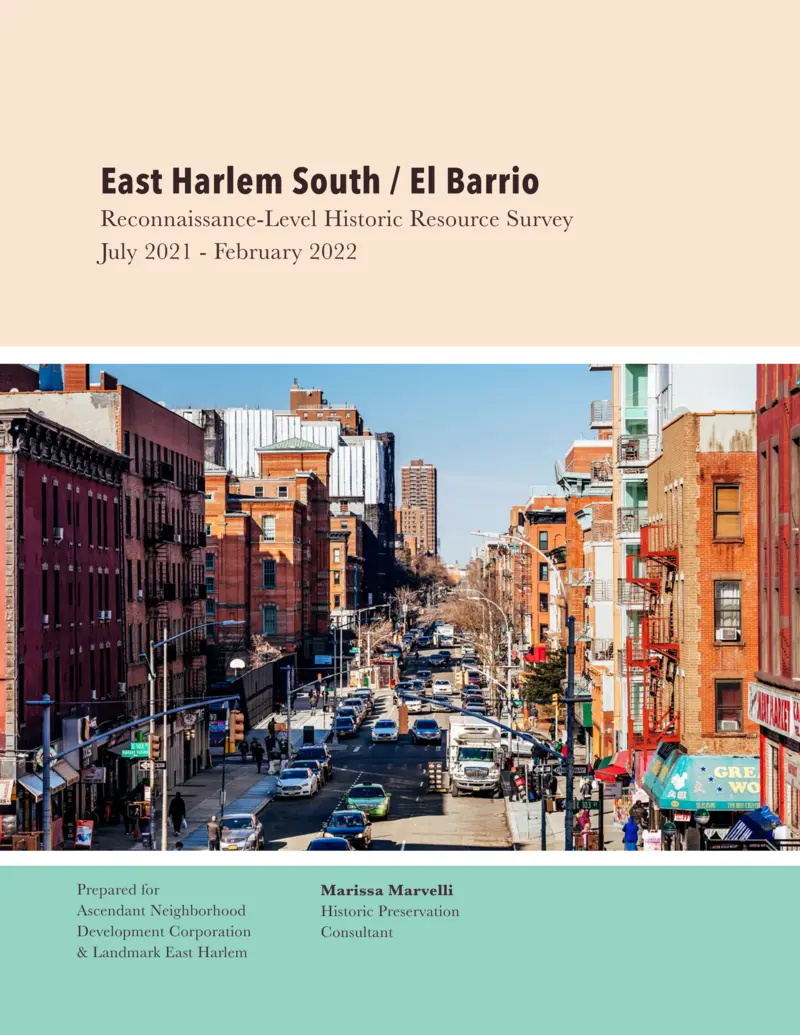
In 2019, after securing additional grant funding from PLNYS, AND hired a consultant to start work on a historic resource survey of East-Central Harlem. SHPO determined historic district eligibility from the findings in this survey in 2020.
Click below to read full report


Ascendant Neighborhood Development is the 501.c3 fiscal sponsor of Landmark East Harlem (LEH). LEH was formed to give the community of East Harlem an ongoing voice in how our neighborhood is developed and to support development that preserves the unique cultural and historical significance of the neighborhood. Landmark East Harlem believes that historic preservation is an indispensable component of a holistic community development strategy. Since 2019, AND has funded all staffing, grant management, and preservation consultants for LEH and has lead the RFE application process and advocated with neighborhood preservation partners.


